
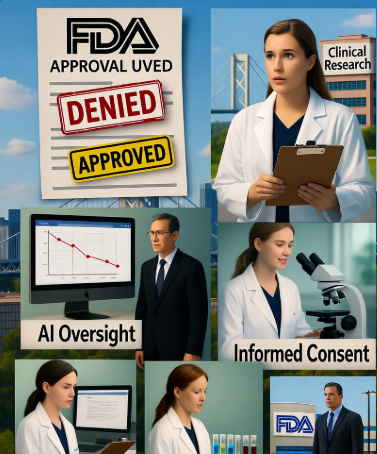
In a bold push to modernize drug approvals, the U.S. Food and Drug Administration (FDA) under Commissioner Marty Makary is accelerating its integration of artificial intelligence (AI) tools, aiming for agency-wide adoption by mid-2025. This “supercharged” approach promises faster reviews and more efficient oversight, but it has sparked intense debate: Is the clinical research industry equipped to handle the heightened scrutiny on key areas like informed consent, recordkeeping, and overall research integrity?
The FDA’s transformation gained momentum earlier this year with the launch of pilot programs using AI for scientific reviews. In May, Commissioner Makary announced a successful test where an AI tool completed a task in just six minutes that typically takes days, setting an aggressive deadline for full implementation across all centers by June 30, 2025. This move aligns with broader efforts to streamline the approval process, which has long been criticized for its lengthy timelines—often spanning 10-15 years and billions in costs. Proponents argue that AI can revolutionize preclinical and clinical trials, reducing development time by up to 50% and slashing costs significantly, as seen in recent AI-driven cancer drug candidates that advanced to testing in just 18 months compared to the industry average of 42.
Yet, this rapid evolution comes with growing enforcement pressures. The FDA’s new draft guidances, released in January and February 2025, emphasize AI’s role in enhancing trial design, patient recruitment, and regulatory workflows while tightening rules on data transparency and post-market surveillance. Areas like informed consent are under particular scrutiny, with frameworks calling for targeted ethical considerations in AI-enabled research, including participant autonomy and risk assessment. Recordkeeping, too, faces amplified oversight; the agency is focusing on closing gaps in clinical trial reporting to ensure research integrity, promoting timely submissions to platforms like ClinicalTrials.gov.
Industry voices are mixed. On X (formerly Twitter), discussions highlight both excitement and caution. One post from clinical research whistleblower Brook Jackson called for suspending approvals reliant on AI-processed data until independent reviews are complete, citing Pfizer’s early use of AI in vaccine trials as a potential red flag. Meanwhile, the FDA’s internal AI assistant, Elsa, has raised alarms after reports of accuracy issues, including fabricated citations and data hallucinations, prompting regulators to double-check outputs and underscoring the need for robust verification.
Experts warn that while AI can parse complex eligibility criteria and match patients to trials with high accuracy—some systems boast F1 scores of 0.891 for extracting medical concepts—the technology’s limitations, such as reliance on synthetic data and interpretability challenges, could exacerbate disparities if not addressed. A recent scoping review of large language models (LLMs) in trial recruitment emphasizes the transformative potential but notes variability in performance and a lack of standardized metrics. In oncology, for instance, AI is poised to improve biomarker testing and equitable access, but only if built on trust, transparency, and subgroup-specific validation to avoid widening care gaps.
Regulatory bodies are adapting. The Multi-Regional Clinical Trials Center released a framework in June 2025 for AI adoption in research, stressing that AI is reshaping diagnostics and clinical decision support but testing the industry’s readiness. The Association of Clinical Research Professionals (ACRP) echoes this in its guidelines for responsible AI oversight, noting that clinical research must balance innovation with individual rights like privacy and confidentiality.
Critics, including former FDA officials, argue the pace risks “rushed science,” especially amid leadership shifts and staff reductions. A Twitter Spaces event titled “Deconstruction of the FDA Approval Process,” hosted by Dan Sfera on October 22, delved into these critiques, highlighting how politics and pharma influence could erode trust. Others, like AI researchers, see opportunity: Benchmarks like BioML-bench show agents performing at 35% of human expert levels in biomedical tasks, suggesting AI as a co-pilot to amplify, not replace, scientists.
As the FDA ramps up AI for enforcement—monitoring for drift in AI-enabled devices and ensuring equitable outcomes—the question looms: How are clinical research teams preparing? Many are investing in governance frameworks, pilot testing, and training to meet the new standards, but gaps in data stewardship and ethical oversight remain. Industry leaders urge collaboration to harness AI’s potential while safeguarding integrity, warning that without proactive steps, the supercharged FDA could outpace an unprepared sector.
For now, the verdict is mixed: The tools are here, but true readiness will depend on how swiftly the industry adapts to this AI-driven era.